Both Teams to Score Checklist: 7 Checks Before a GG Tip
admin · November 1, 2026
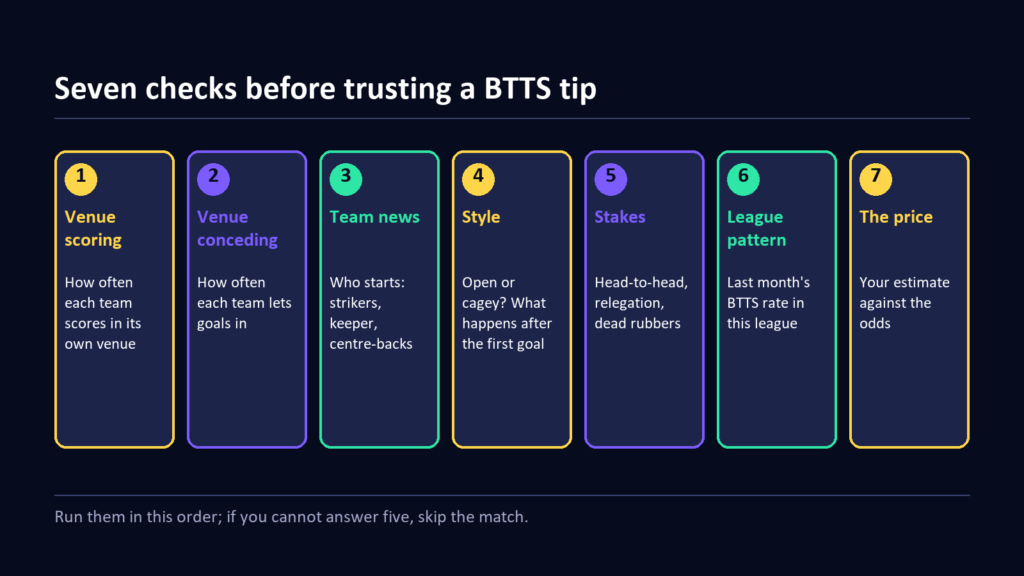
Before you trust a both teams to score tip, run it through a short checklist: how often each side scores in the venue it will play in, how often each concedes, whether the key players are fit, how the game is likely to be played, and whether the price still makes sense. A BTTS (GG) pick is a claim about two teams at once, and most bad ones fail because only one of them was checked. This guide gives you the seven checks we use, in the order we use them, with a worked example you can copy.
What a BTTS tip is really claiming
Both teams to score means each side finds the net at least once in the 90 minutes plus stoppage time. The final score does not matter: 1-1, 3-2 and 1-4 all count. That makes it different from a win or draw pick, because you do not need to decide who is better. You only need to decide whether both attacks will break through and whether both defences will leak.
That sounds easy, but it hides two separate questions. Can the home team score against this particular opponent? Can the away team score at this particular ground? A tip that answers only one of them is half a tip. If you browse the BTTS / GG predictions on Socapredict, notice how each match is a pairing, and how the same club can be a good GG candidate in one fixture and a poor one in the next.
Check 1: scoring rate in the right venue
Start with how often each team scores in the setting it will actually play in. A side that scores in nine of its last ten home games but only four of its last ten away is two different attacks. Use the home team’s home record and the away team’s away record, not the season totals.
Look at the share of matches with at least one goal, not the average number of goals. A team that scored five once and was blanked three times can have a decent average and still fail the “will they score” question most weeks. Frequency answers it. Averages mislead.
Check 2: how often they concede
Now do the same for goals against, again by venue. You want to know how often the opponent’s net is breached, not how many. A team that concedes once in most games is a better GG candidate than one that ships four on rare bad days and keeps clean sheets otherwise.
A quick way to put checks 1 and 2 together is to count, for each team in its venue, the share of recent matches in which both sides scored. If that number is above half for both teams, you have a candidate. If one team sits well below, drop the pick or look for a different market.

Check 3: team news that changes the picture
A missing striker lowers the chance that his side scores. A missing centre-back or goalkeeper raises the chance that it concedes. These two effects pull in opposite directions, so a single absence can make a GG pick safer or shakier depending on which team it hits.
Look at who is likely to start, not who played last week. If the first-choice keeper is out and the replacement has little top-level experience, the opponent’s chance of scoring goes up a little. If the main creator is suspended, the same team’s chance of scoring goes down. Read the line-ups an hour before kickoff when you can, and treat an early tip as provisional until they are confirmed.
Check 4: the style of both teams
Numbers describe what happened. Style tells you why. Two teams that both press high and leave space behind their full-backs tend to trade chances. Two cautious sides that sit deep and play for a draw tend to produce fewer shots and fewer goals. A strong team that dominates possession against a low block can win 2-0 without conceding, even if both teams have leaked goals in the past.
Ask a simple question: if the favourite scores early, what does the underdog do? If it has to come out and attack, the game opens and both teams often score. If it keeps its shape and defends, GG becomes less likely. The reverse is also true when the underdog scores first and the favourite pushes everyone forward.
Check 5: head-to-head and the stakes
Head-to-head records are weak evidence on their own, because squads and managers change. They are still worth a glance as a sanity check. If both teams scored in the last four meetings under the same managers, that matches what the style check suggested.
The stakes matter too. A relegation six-pointer often tightens up. A dead rubber at the end of a season or a cup tie with rotated squads often loosens defences. Late in a tournament group, a team that needs a win and a team that needs only a draw will approach the game very differently.
Check 6: league and competition context
Different competitions have different scoring habits. Some leagues see both teams score in a large share of matches, others far fewer. Instead of memorising a table of percentages, compare your match to the recent pattern in the same league: how often did both teams score in the last round, and the round before? A single weekend is noise, but a league that has been clearly high-scoring or low-scoring for a month is worth respecting.
Cup ties and friendlies deserve extra caution. Squads change at half-time, intensity varies, and the form from league games transfers poorly.
Check 7: the price
The last check is the one most people skip. A tip is not good or bad on its own. It is good or bad relative to the odds. If a GG pick at a low price needs to land about three times in four just to break even, you need to be confident it is more likely than that. If you cannot say why it is more likely than the price implies, the tip may be right and still not worth taking.
This guide is about understanding football, not about promoting wagering. If you follow predictions, treat them as research, keep any stakes to what you can afford to lose, and never chase losses. No tipster can promise results, and a good tipster says so.
A worked example (illustrative)
Here is how the checklist works on an invented fixture, so you can see the logic without relying on real numbers. Team A is at home to Team B. These figures are made up for illustration.
- Check 1: Team A scored in 8 of its last 10 home games. Team B scored in 6 of its last 10 away games.
- Check 2: Team A conceded in 7 of its last 10 home games. Team B conceded in 8 of its last 10 away games.
- Check 3: Team B’s first-choice centre-back is suspended. Team A’s main striker is fit.
- Check 4: Both teams play with a high line and full-backs who push on.
- Check 5: Both scored in the last three meetings. Neither side has anything to protect.
- Check 6: The league has seen both teams score in most games this month.
- Check 7: The odds imply roughly a 60 percent chance, and your own estimate is 70.
Six checks point the same way and the seventh shows a small edge, so the pick is reasonable. Change one input and the answer changes. If Team B’s striker were out and its away scoring rate were three in ten, the tip would fail at check 1, and no amount of enthusiasm for the other six checks would save it.

Common mistakes with GG tips
- Using season averages. Venue and recent form are more useful than a full-season number.
- Checking one team only. A prolific attack means little if the opponent keeps clean sheets.
- Ignoring line-ups. A tip written the day before can be wrong by kickoff.
- Chasing a streak. Five GG results in a row do not make the sixth more likely. Each match is its own event.
- Forgetting the price. A correct prediction at a poor price still loses value over time.
How BTTS differs from over 2.5 goals
People often mix the two markets up. Over 2.5 needs three goals in total, from either side. BTTS needs one goal from each. A 3-0 win is over 2.5 but not GG. A 1-1 draw is GG but not over 2.5. The two overlap in games like 2-1 and 2-2, which is why they are often grouped together. If you want to compare how the same match looks in both markets, the over 2.5 goals prediction section is a good next stop. Our own explainer on corners, cards and both teams to score covers how the stat is counted and why it behaves differently from total goals.
To see how a prediction record compares to results over time, you can also follow fixtures and results on Scoredium and check a few picks yourself. Doing that for a month teaches more than any single guide.
A one-minute version of the checklist
- Venue scoring rate for both teams.
- Venue conceding rate for both teams.
- Confirmed or likely line-ups.
- Style and likely game state.
- Head-to-head and stakes.
- League scoring pattern this month.
- The price against your own estimate.
If you cannot answer at least five of these with real information, skip the match. There is always another one tomorrow.
FAQ
What does GG mean in football predictions?
GG stands for “goal goal” and means both teams score. It is the same market as BTTS (both teams to score). A “Yes” selection wins if each side scores at least once in normal time plus stoppage time, regardless of the final result.
Is BTTS more reliable than a win or draw prediction?
Not necessarily. It avoids deciding who wins, but it still needs two attacks to score and two defences to concede. The error rate depends on how carefully you check both teams, not on the market itself.
Does extra time count for BTTS?
Usually not. Standard BTTS is settled on 90 minutes plus stoppage time. Extra time and penalty shootouts are normally excluded, though rules can differ by site, so read the terms before you rely on a tip.
How many recent matches should I look at?
Six to ten matches in the right venue is a reasonable window. Fewer is noisy, and more can include a different squad or manager. If the team changed coach recently, weight the games under the new one more.
Can I use the same checklist for other leagues?
Yes. The steps are the same everywhere. What changes is the scoring pattern in check 6, so recalculate that for each competition instead of copying numbers from another league.